Web App
Bean Relay E-commerce
A platform that connects you to good quality Kenyan Arabica coffee.
Jun 2024
Web App
Case study
The story behind Bean Relay E-commerce
BeanRelay — Coffee Commerce & Subscriptions
Connecting coffee discovery, payments, and repeat deliveries through one checkout.
BeanRelay is a coffee-commerce platform I’m building for businesses that need a connected way to sell coffee, accept payments,s and manage repeat purchases. It combines a Next.js storefront with a modular NestJS backend, integrating M-Pesa, Stripe,pe and customer-approved subscription renewals.
The challenge
Choosing coffee involves more than selecting a product. Customers need to understand bag sizes, roast levels, grind options, and delivery schedules before committing to a purchase.
Behind the storefront, the business needs clarity too. A submitted payment request is not necessarily a confirmed order. Delayed responses, unsuccessful payments, and unpaid subscription renewals all need a clear next action.
The challenge was to connect these decisions into a buying experience that customers could follow and a backend workflow the business could manage.
My role
I work across product design, frontend development, backend architecture, data modelling, and payment integration.
The project evolved from an existing coffee-storefront codebase into a broader commerce product. My background as both a coffee roaster and software engineer helped me identify which coffee details belong in the buying journey—and which information can wait until the customer needs it.
What I built
Coffee discovery and variant selection
The catalogue presents product imagery, tasting notes, roast information, and available sizes. Customers can compare offers and select the variant they want before entering checkout.
A shared checkout
Normal purchases and subscription deliveries use the same address-book interface, order summary and payment components. Subscription payments use their own delivery order, keeping them separate from unrelated items in the customer’s cart.
M-Pesa and card-payment workflows
The platform integrates M-Pesa STK push and Stripe payments, with interfaces for pending responses, recoverable errors, and payment-status checks. The payment-review work gives uncertain transactions a path to resolution instead of immediately asking the customer to pay again.
Customer-approved coffee subscriptions
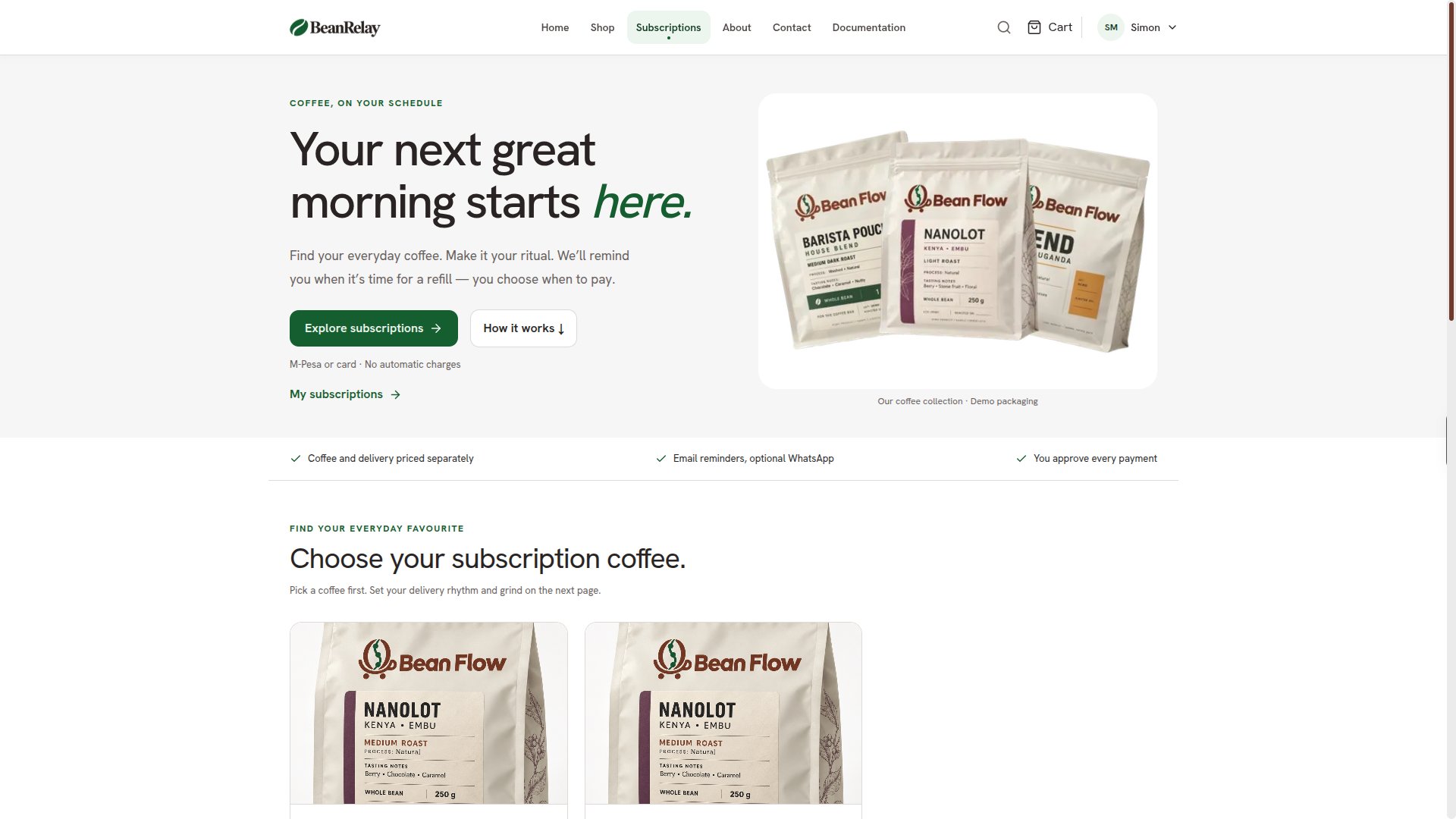
Customers first choose a subscription coffee, then configure an available delivery schedule and grind. A live summary keeps their selection visible before they continue to checkout.
Coffee and delivery charges are presented separately. Each renewal requires payment approval, and subscription management lives on a dedicated My subscriptions page.
Authentication that preserves progress
The sign-in flow retains a validated local return URL, including checkout parameters. Customers can authenticate and continue from their selected plan instead of being sent back to the homepage.
Engineering decisions
I organised the NestJS backend around catalogue, orders, payments, notifications, and subscriptions, using TypeORM and PostgreSQL for persistence and Redis with BullMQ for background work.
On the frontend, reusable Next.js components share the existing Tailwind theme. React Hook Form handles forms, RTK Query manages API requests, and Zustand supports local workflow state where needed.
The aim is to support different storefront designs against a consistent commerce API. Tenant-aware company accounts, team access,s and SaaS plans form the next stage of that product direction.
The result so far
BeanRelay now has a clearer journey from choosing coffee to configuring repeat deliveries and entering checkout. Payment exceptions and subscription management have defined places in that journey.
The product remains in active development. Targeted automated checks cover checkout behaviour, subscription selection, and authentication return paths; live payment and operational validation continue alongside that work.
What I learned
The hardest problems often sit between features: preserving a selected plan through sign-in, distinguishing a pending payment from a paid delivery, and reusing checkout without mixing different order types.
Those connections shape how I build commerce software: the interface should explain what happens next, and the backend should support that promise when requests are delayed or fail.
Building a storefront, integrating payments, or developing an API-led product? Let’s discuss your project.
Tech Stack
Gallery
Project Showcase
Ready to Build Something Great?
Let's work together to bring your ideas to life.

